Tell us about the job
Takes about a minute. No obligation.
A contractor diagnosing a boiler repair in Essex County starts by accounting for how hard the burner and ignition system have been cycling. Homes in Essex County, NJ run heat about eight months a year, from October through May. Burners that fire repeatedly across that kind of sustained demand develop wear patterns in the ignition components, heat exchanger, and circulator that shorter heating climates simply do not produce at the same rate. When a boiler faults, a contractor here checks those high-cycle parts first, because that is where the load shows up.
Much of Essex County's housing was built for cast-iron radiator systems and the supply lines that fed them, and the boilers that eventually replaced original equipment in those houses drew from parts catalogs that have since thinned considerably. Half the homes in Essex County, New Jersey were built in 1958 or earlier (2020-2024 ACS 5-year). A contractor opening a boiler here may find that the heat exchanger section, the circulator flange, or a zone valve body is no longer manufactured to the original specification, which changes the repair from a parts swap to a parts search or a fabrication call. That gap between what the system requires and what a supplier can ship is where the job either stays straightforward or gets complicated.
The Parts of a Boiler a Contractor Checks First
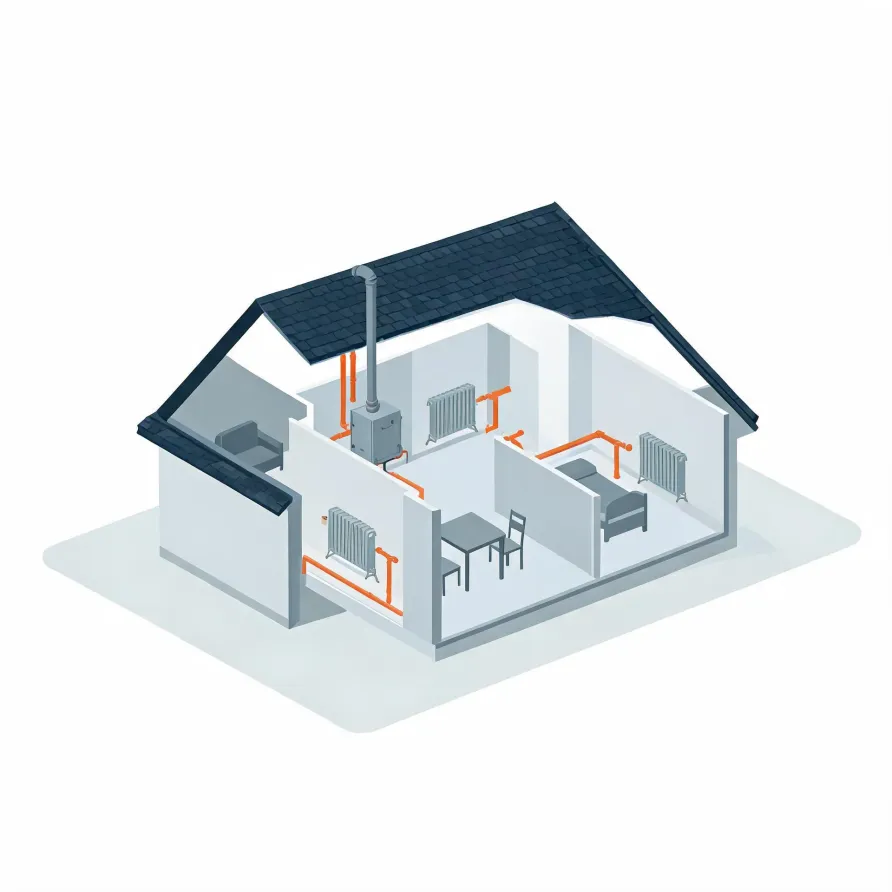
The boiler itself sits in the basement or a mechanical room and is the piece a contractor goes to first. It heats water and pushes it through the system. When heat is uneven, when the unit short-cycles, or when it runs but delivers nothing, the burner assembly, heat exchanger, or pressure vessel is usually where the problem lives.
Radiators or baseboard convectors sit in the living spaces and are the pieces a homeowner notices when something is off. The circulator pump moves heated water to them. The expansion tank, pressure relief valve, and aquastat each keep the system within safe operating limits, and any one of them can be the source of a pressure problem, a lockout, or a temperature that will not hold.
The drawing shows a typical boiler layout, and a licensed contractor determines which components apply to the specific system in your home.
Get matched in Essex CountyEssex County, by the numbers
102 severe weather events were recorded in Essex County, New Jersey between 2015 and 2024.
NOAA National Centers for Environmental Information, Storm Events Database, bulk CSV export, events 2015-01-01 through 2024-12-31.Half the homes in Essex County, New Jersey were built in 1958 or earlier (2020-2024 ACS 5-year).
U.S. Census Bureau, 2020-2024 American Community Survey 5-Year EstimatesEssex County, New Jersey holds 336,962 housing units (2020-2024 ACS 5-year).
U.S. Census Bureau, 2020-2024 American Community Survey 5-Year EstimatesOwners occupy 44.9% of the occupied homes in Essex County, New Jersey (2020-2024 ACS 5-year).
U.S. Census Bureau, 2020-2024 American Community Survey 5-Year EstimatesBoiler Repair Rules & Standards on the Books for Essex County, New Jersey2 sourced regulations and codes
What Essex County and New Jersey Require for HVAC Repair
In New Jersey the HVACR licence is the State's alone: a municipality, local board of health or any other agency may not issue or renew a Master HVACR contractor's licence.
New Jersey requires a Master HVACR contractor licence: no person or business may engage in the business of HVACR contracting, or advertise as a Master HVACR contractor, without being authorised under the State HVACR Contracting License Law.
Severe Weather Events in Essex County
Boilers in Essex County work hardest when outdoor conditions are at their worst. Stress on heating equipment tracks closely with what the weather demands, which is why local storm history is part of understanding repair needs here.
102 severe weather events, 2015–2024. Source: NOAA National Centers for Environmental Information, Storm Events Database.