Why your boiler won't turn on in a New Jersey winter
Once you send the form, finding a pro is off your list.
A cold house in January is not something you can sit with for long. If your boiler won't fire, won't hold a flame, or just clicks and stops, you want it looked at today, not after you've spent an evening on the phone with three different companies.
Boilers fail for a short list of reasons. A closed valve, a pressure that's dropped too low, an igniter that won't spark, a circulator pump that's seized. Some of these a thermostat reset won't touch. A contractor who works on boilers all winter in New Jersey has seen whatever yours is doing before, probably last week on another street.
That's the point of calling someone local instead of guessing from a forum post. Gas heat is what most houses here run on, and a boiler that's down in the middle of a cold stretch isn't a project to figure out yourself at midnight. It's a repair that needs someone who knows the equipment, in your town, today.
Send the request once and it goes to one licensed contractor near you, not a pile of companies competing for the job. That means your phone isn't ringing off the hook the rest of the afternoon. It means the person calling you back already knows roughly what kind of boiler you have and what tends to go wrong with it this time of year.
Once you send it, the work of finding someone is off your plate. You're not the one tracking down a name, checking a license, hoping they call back. That part is done. What's left is heat coming back into the house, and someone who already knows boilers showing up to make that happen.
A boiler that won't turn on usually comes down to the ignition system or the safety controls that watch over it. On older gas boilers, a pilot light can get blown out or lose its draft, and the thermocouple that senses the flame shuts off the gas if it doesn't detect heat. On newer boilers with electronic ignition, a cracked igniter or a dirty flame sensor will stop it the same way. Low water pressure is another common cause. Winter cold makes a boiler run long, frequent cycles, and that strain tends to expose whichever part was already weak. A pressure switch, a failed thermostat, or a tripped high limit switch can all read as "nothing happens" from where you're standing, even though the boiler itself is trying. None of these are something to diagnose by guessing. A boiler that won't fire in a New Jersey winter needs someone to open it up and test each part in order until they find the one that failed.
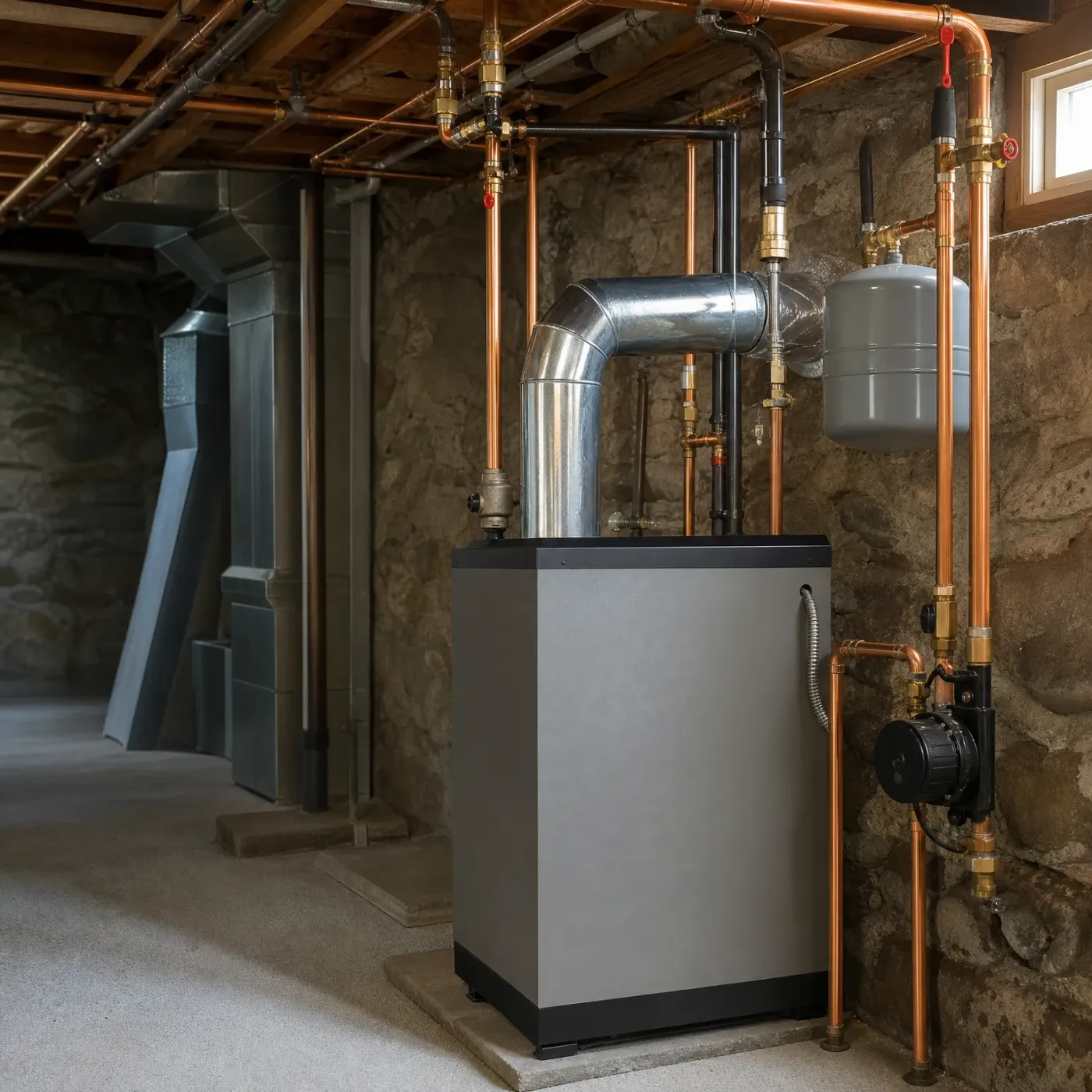
A boiler like this keeps its pumps and pipework in plain sight, so a tech can spot a seized valve or a weeping fitting fast.
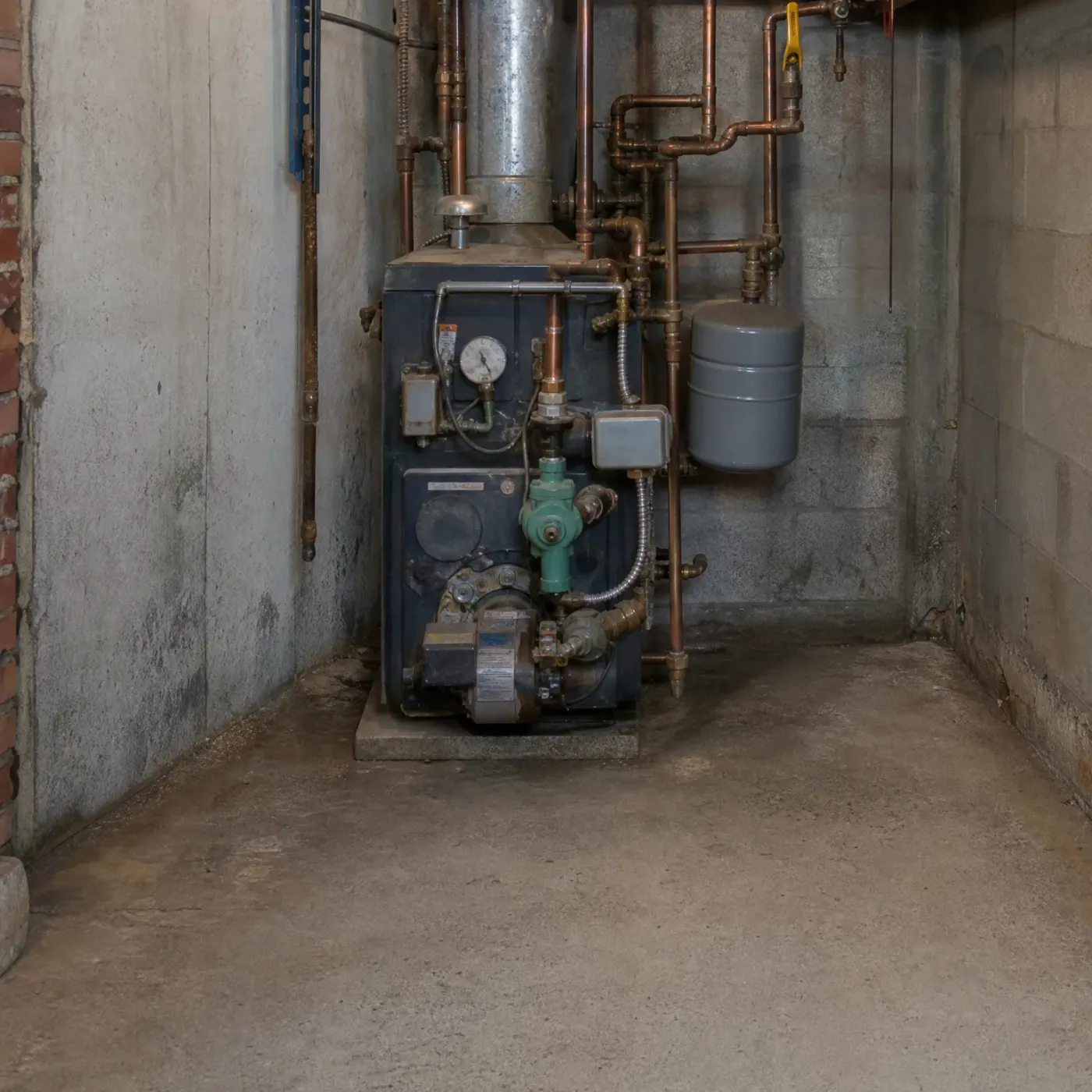
This one's pressure gauge and burner are easy to check, but a flue that's corroding or blocked is what actually stops it from firing.
Boilers don't just fail to start. Something inside them decides not to let the burner fire, and that decision is usually the right one. Water pressure under about 12 psi trips the low-water cutoff, because running a burner without enough water in the system would damage it fast. Try to ignite three or four times without a flame catching, and the control board locks out on purpose, waiting for a reset rather than risking gas building up. High-efficiency boilers add a condensate line, and when that line clogs, a float switch catches it and kills the burner before water backs up into the unit. The expansion tank and the pressure relief valve work as a pair, and a tank that's gone waterlogged can push pressure high enough that the system shuts itself down rather than risk a bigger problem. Even a seized circulator pump can leave you with a burner that's lit and a house that's still cold, because heat has nowhere to go if the water isn't moving. Each of these is a safety doing its job. The part just needs a tech's hands on it.
What's Actually Stopping the Burner
A low-water cutoff will stop the burner from firing if the boiler's water pressure has dropped below about 12 psi.
Most boilers lock out after three to five failed ignition attempts and need the control board reset before another try.
A clogged condensate line on a high-efficiency boiler backs up and trips a float switch that cuts off the burner.
The pressure relief valve and expansion tank work together, and a waterlogged tank can push pressure high enough to shut the system down.
A cracked heat exchanger will trip a flame rollout or pressure switch well before it lets the boiler run.
The circulator pump can hum without moving water if its bearings seize, leaving the burner fired but the house still cold.
Hand off the boiler problem
Only one pro gets your request, so you hear from one company.
After you send the request, you're done searching.
Most control boards let you press reset once and try again, and that clears a lot of failed ignition attempts on its own.
If the boiler lost power during a storm, it should restart on its own once power comes back, so check the breaker first.
A pilot light that's just been blown out by a draft can sometimes be relit by hand if you can reach it safely.
This costs nothing and takes a few minutes, so it's worth trying before anything else on a cold morning.
If the same lockout happens again within a day, resetting again won't fix whatever's actually causing it.
Call for repair
A tech who works on boilers all winter in New Jersey has seen which parts fail first in this kind of cold snap.
A thermocouple, ignitor, or low-water cutoff that's actually failing needs testing with a meter, not guesswork from across the room.
One licensed contractor means one visit and one diagnosis, instead of fielding calls from several companies while the house sits cold.
A flue that's corroding or a condensate line that's clogged can look like an ignition problem until someone opens the boiler up.
Repeated lockouts are the board protecting the boiler from a real fault, and that fault doesn't go away on its own.
A local contractor already knows the gas pressure and venting quirks common to boilers installed in this area.
Running the way it should
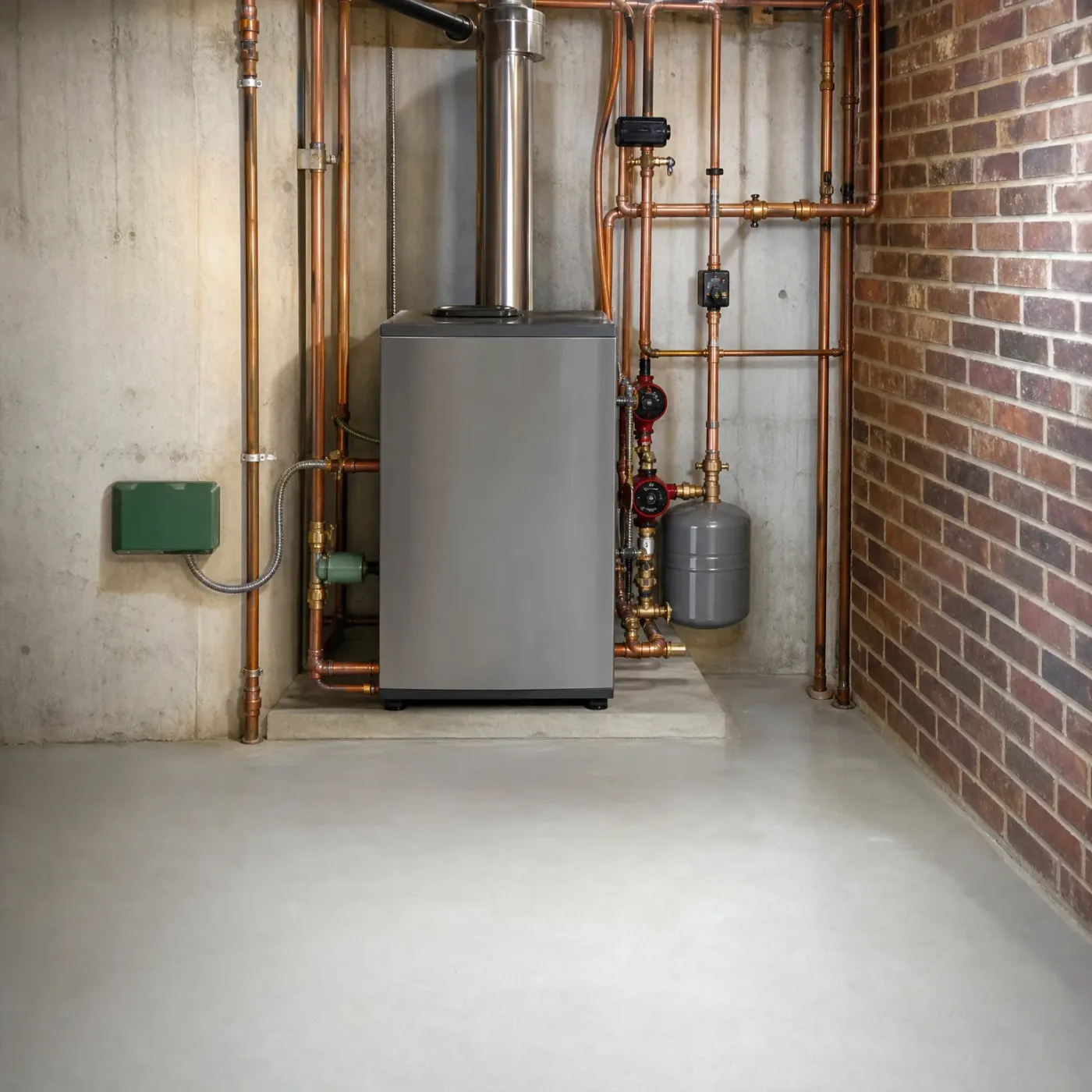
A boiler like this is doing its job quietly. Water moves through the copper pipes, the pumps push it where it needs to go, and the gauge holds steady. Nothing here is fighting for air or straining to light. This is what you want to find when you go down those basement stairs.
Struggling to fire
This older oil-fired boiler has the same pipes and pumps, but age catches up with a unit like this. The flue pipe can corrode or clog over years of use, and the circulator pump wears out. When a boiler this age won't start, it's often one of these older parts giving out, not something minor.
Winter nights average 26°F statewide
At 26°F overnight, your boiler's burner is cycling on for longer stretches to keep the house warm, and it's firing more times a night than it would in a milder month. That's more chances for a weak ignition or a tripped safety to stop it cold before morning.
NOAA nClimDiv 1991-2020 county normals weighted by homes
What a cold boiler means tonight
Most boiler failures trace back to the ignition system or a safety control doing exactly what it's built to do.
A thermocouple, a flame sensor, or a low-water cutoff shutting things down is the boiler protecting itself, not breaking down.
A local tech who works on boilers all winter has seen the same failures enough times to know where to look first.
One licensed contractor takes the job, so you're not fielding calls from several companies while your house sits cold.
Clearing a lockout at the panel sometimes gets the burner firing again, but a control board that keeps tripping needs someone qualified to find out why.
Knowing what stopped the boiler matters less than getting someone there who can get it running again.
A boiler that won't fire is almost never broken in the way people fear. Most of the time it's the ignition system or a safety control doing its job, catching something wrong and shutting the burner down before it causes a bigger problem. A thermocouple that senses no flame, a flame sensor that's gone dirty, a low-water cutoff that trips when pressure drops below where it should be. These are the parts that failed, and they're also the parts built to fail safely rather than let gas run without a flame to burn it. None of that tells you how to fix it tonight, and you shouldn't need to figure it out alone in a cold house. What matters now is getting someone in front of the boiler who's seen this exact shutdown before, more than once this winter, in a house not far from yours. A tech who works on boilers all season knows which control trips first on a system like yours and checks there before anywhere else. You send one request and it goes to one licensed contractor local to you, not a handful of companies competing for the callback. No juggling calls, no explaining the problem three times to three different people. Just the one contractor who takes the job and shows up knowing boilers, because that's the work they do every winter here. Whatever tripped the shutdown, the fix starts with someone qualified standing in front of it.