Profile view of a bearded man wearing a black baseball cap and a dark gray T-shirt against a plain light background.

How long a boiler lasts in New Jersey

Step 1 of 3: Equipment

A gas boiler in New Jersey lasts about 15 to 20 years. Most homes here heat with gas, and a boiler that gets a yearly checkup and isn't pushed through corners it can't handle will often reach the far end of that range. What shortens it is age catching up with the heat exchanger and the controls, or a unit sized wrong for the house from the start. Past 15 years, repairs get harder to justify since parts for an older model take longer to find and cost more when they turn up. Once a boiler is past that mark and starts needing attention more than once a season, that's usually the sign it's nearing the end rather than mid-repair. Knowing where your system sits on that timeline tells you whether you're looking at another repair call or a replacement.

A woman with dark hair in a bun reclines on a sofa with her eyes closed, wrapped in a cream fleece blanket, a closed blue hardcover book resting in front of her, with a lit lamp and a vase of dried flowers in the background.
A smiling bearded man in a navy sweater sits at a candlelit dinner table with a glass of red wine, a bowl of salad, and plates of food in the foreground.

What wears a boiler out early

Hard water leaves scale inside the heat exchanger, and that scale makes the burner work harder to push heat through it. A boiler that short cycles, turning on and off instead of running a full cycle, stresses the ignition system and the pump over time. Corrosion in the flue or at pipe joints points to a leak that's been going unnoticed. None of this shows up overnight. It shows up as a gas bill that creeps up a little more each winter and a boiler that needs more small repairs than it used to.


What stretches it past 20 years

A boiler that gets looked at once a year, before the cold sets in, tends to catch a worn part before it fails outright. Clean water run through the system and correct pressure keep the heat exchanger from scaling or cracking under stress. Sizing matters too. A boiler matched to the house runs steadier than one too big or too small for the rooms it heats. None of this guarantees a particular number of years, but it's the difference between a boiler that limps through its last few winters and one that doesn't.

A smiling man in a dark navy sweater sits on a light sofa in a living room, with a glass bowl of popcorn on a wooden coffee table and bookshelves behind him.
A smiling man in a dark green sweater sits on a tan leather sofa in a dimly lit living room, with a bowl of popcorn in the foreground and a kitchen area blurred behind him.
A smiling middle-aged man in a dark shirt sits on a gray sofa in a living room, with a bowl of popcorn on a side table and shelves, a window and kitchen area behind him.
A smiling bearded man in a dark gray t-shirt sits on a gray couch in a living room, with a large glass bowl of popcorn on a wooden table in the foreground.

A boiler doesn't push heated air through ducts. It heats water in a sealed chamber and sends it out to radiators or baseboards, then draws it back to be reheated. The aquastat is what tells the burner when to fire, reading the water temperature and calling for heat only when it drops. Pressure is kept low by design, and the relief valve letting a little water out when pressure climbs is the system doing its job, not breaking down. Circulator pumps are what actually move the hot water to each zone, so if one seizes up, that zone goes cold while the rest of the house stays warm. The expansion tank gives that heated water room to expand into, and if it waterlogs, the relief valve ends up opening more than it should. The low water cutoff is the part that matters most for the boiler's lifespan. It shuts the burner off before it fires into an empty chamber, which is what keeps the heat exchanger from cracking.

How a boiler actually works

  • A boiler heats water in a sealed chamber and sends it through pipes to radiators or baseboards rather than pushing heated air through ducts.
  • The aquastat reads the water temperature and tells the burner when to fire, so a stuck or miscalibrated aquastat can run the boiler longer than it needs.
  • Pressure inside the system stays low on purpose, and a pressure relief valve lets water out if it climbs too high, so a valve that drips is checking the system, not failing on its own.
  • Circulator pumps move the heated water out to each zone, and a pump that seizes or loses its bearing leaves that zone cold while the rest of the house heats fine.
  • Expansion tanks give the heated water somewhere to go as it expands, and a waterlogged tank forces the relief valve to open more often than it should.
  • Low water cutoff switches shut the burner down before it fires with no water in the chamber, which is what actually protects the heat exchanger from cracking.
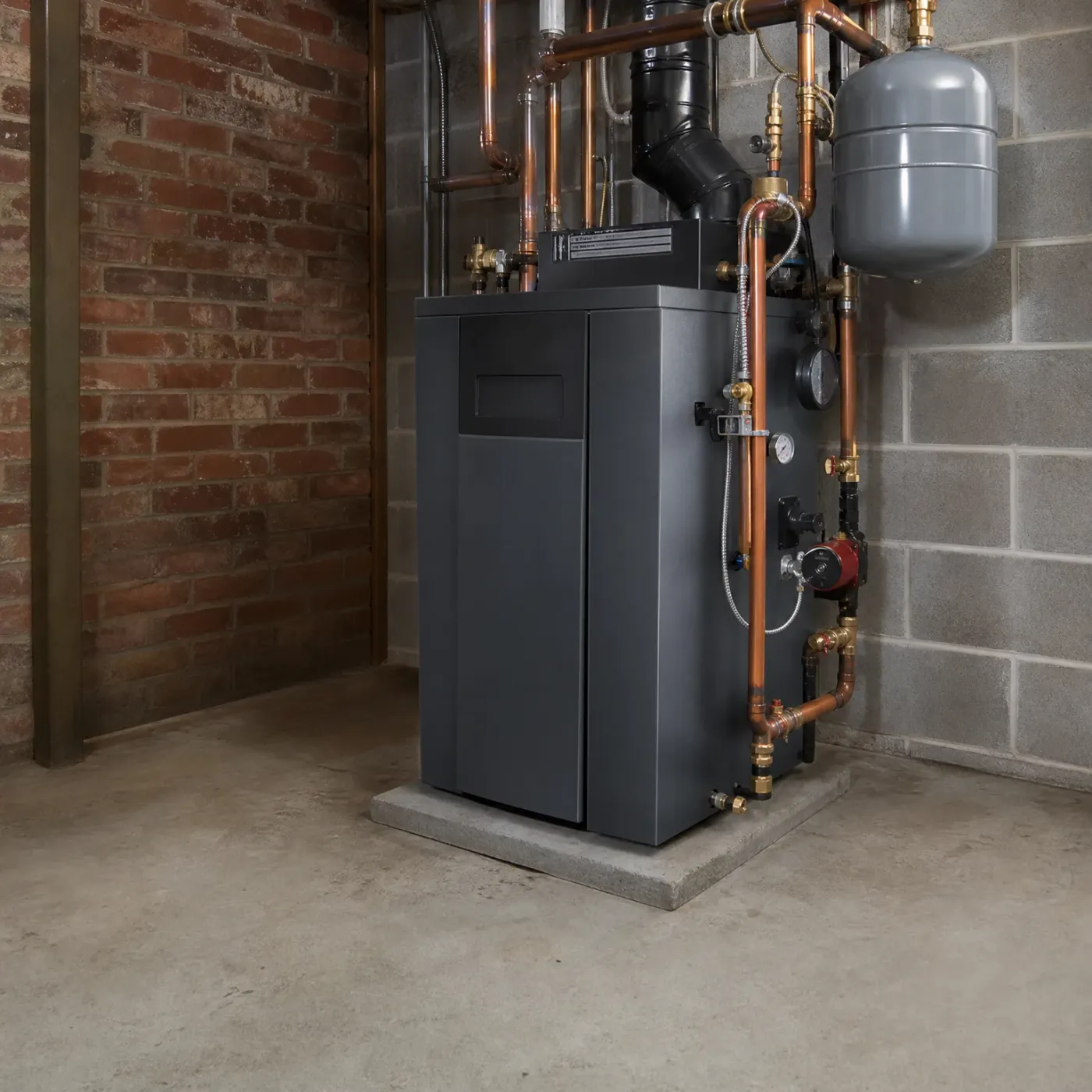
A dark gray floor-standing boiler on a concrete pad in a basement, connected to copper piping, valves, a circulator pump, a gauge, a black flue pipe, and a gray expansion tank, with a brick wall on the left and concrete block wall behind.
A boiler running right holds steady pressure, clean connections, and a tank doing its job without strain.
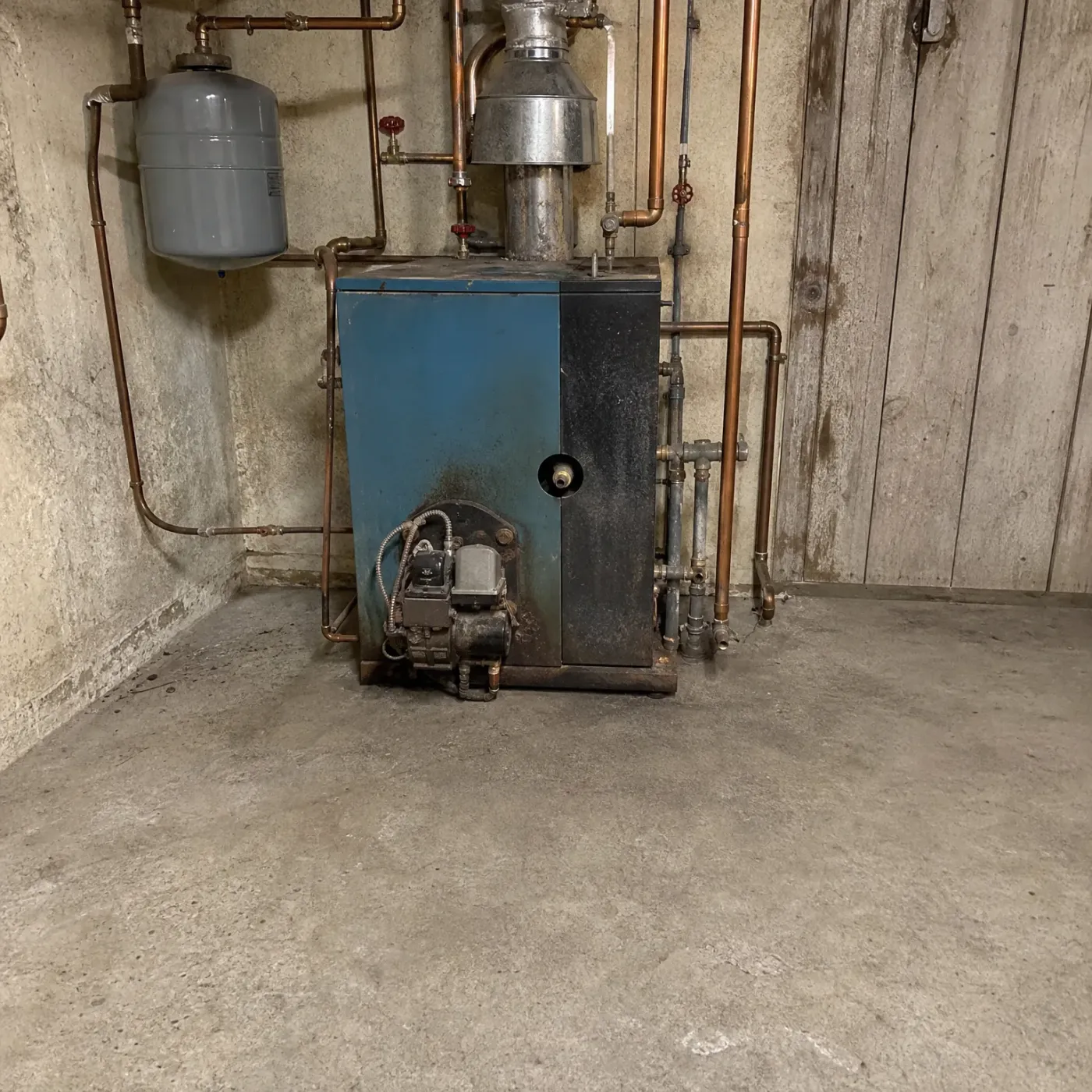
A blue and black boiler with a burner unit, flue, expansion tank and copper and steel piping stands on a concrete basement floor against a concrete wall and wooden plank partition.
Rust at the fittings, scorched metal, and a tank that's labored for decades mean the next cold snap could end it.
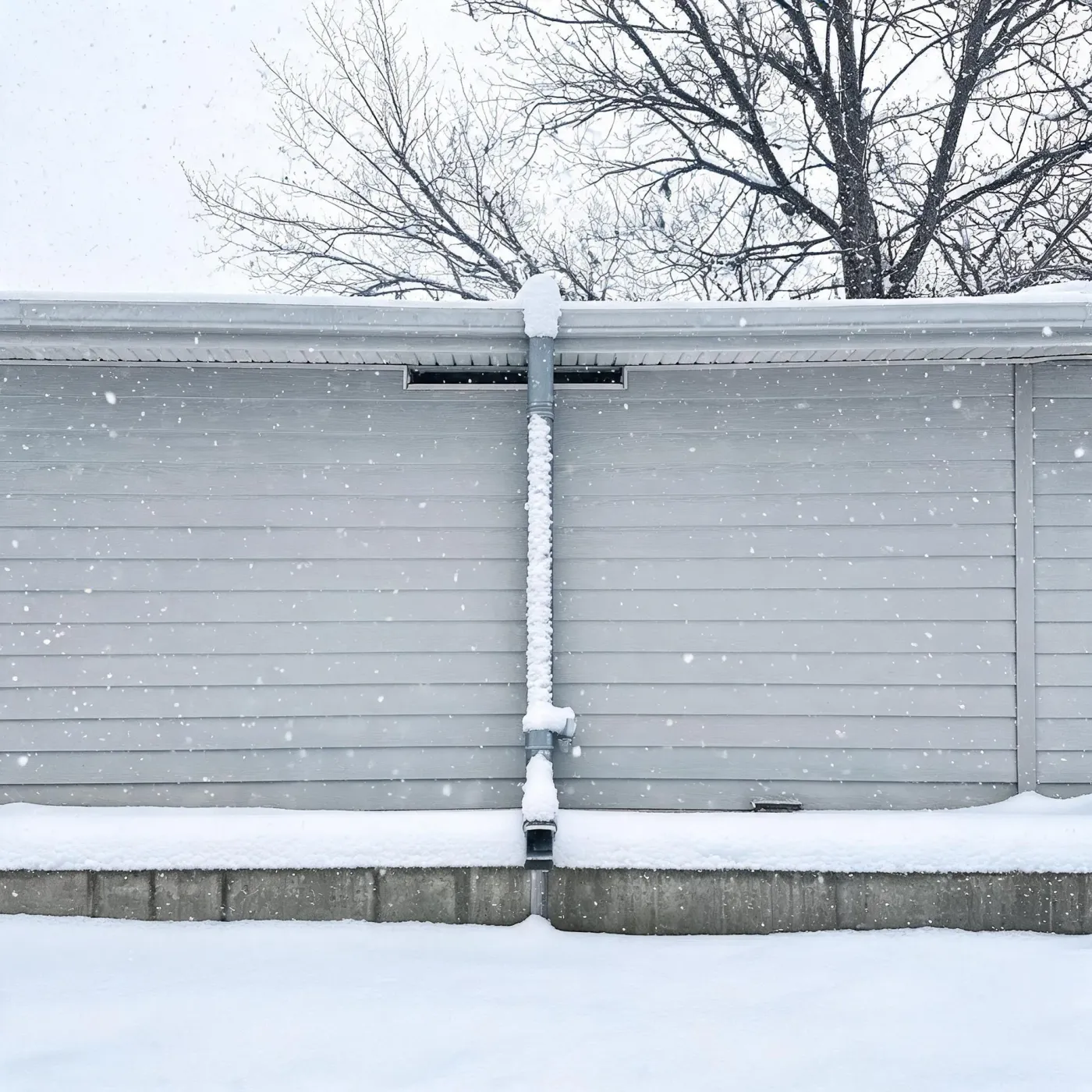
Exterior wall of a building with light gray horizontal siding and a snow-covered downspout running down its center, with bare trees behind the roofline and falling snow over deep snow on the ground.

On a January night here, the temperature outside averages 26°F, according to NOAA. That's the kind of cold that keeps a boiler firing on and off most of the night instead of cycling down. An older unit, especially one with scale built up or a burner that's lost some of its punch, has to run longer stretches to hold a house at temperature, and you'll notice it in rooms that used to warm up fast now taking their time. If your boiler's been in since before you moved in, a local installer who services this equipment all winter can tell you in one visit whether it's still got years in it or whether a cold snap like this is the kind that finds the weak point. You'd be working with one contractor who knows the area's water and weather, not a handful of companies competing for the job.

NOAA nClimDiv 1991-2020 county normals weighted by homes

Send one request and you're done looking

A boiler that's run twenty winters in New Jersey isn't going to announce the end. It just starts costing more each month to do the same job, firing longer to push heat through baseboards it used to handle easily. You've likely watched the gas bill climb and wondered if that's just how an older unit runs now. It is, and it's also the point where replacing it stops being a maintenance question and starts being a planning one. A local contractor who services boilers in this state all winter knows which brands hold up to the scale and short cycling New Jersey water causes, and what a straight swap looks like in a house like yours. Sending the request means one contractor looks at your setup, not a handful of them competing for the job. Before the next cold snap tests whatever's left in that tank, it's worth having someone who already knows the answer look at what you've got.

A dark gray floor-standing boiler in a concrete-walled basement, connected to copper piping, circulator pumps, a gray expansion tank, and a cream-colored storage tank to the left.

Running right

The pipes stay tight, the fittings clean, the pumps quiet. Pressure holds steady where it should, and the expansion tank beside it is doing its job without strain. A boiler like this is heating the house the same way it did ten years ago.

A gray residential boiler with a metal flue pipe stands in a concrete-block basement corner, surrounded by copper piping, valves and a gray expansion tank.

On its way out

The flue pipe shows its age, and so does everything connected to it. Pressure drifts, fittings corrode, and the unit works harder each winter to push the same heat through the baseboards. This is what's sitting in a lot of New Jersey basements right now, still running, not for much longer.

A gray boiler on a concrete pad in a basement with painted concrete block walls, copper piping, a metal flue, and electrical control boxes.
Before you get your boiler installation
A gray boiler with a metal flue pipe stands in a basement against concrete and concrete-block walls, connected to copper piping, a circulator pump, and two gray expansion tanks.
After you get your boiler installation

Where your boiler stands now

  • A gas boiler in New Jersey that gets yearly service and isn't overworked will typically run 15 to 20 years before it needs replacing.
  • Scale, short cycling, and rust at the fittings are what cut that life short, not the calendar on its own.
  • A January night here averages 26°F, and that's the kind of cold that exposes an aquastat or burner already past its prime.
  • A licensed local contractor who services boilers all winter knows which parts fail first in homes like yours.
  • Matching with one contractor instead of several means one visit, one straight answer, and no round of competing calls to sort through.
  • Once you know where your boiler stands, the next step is finding out whether it's worth repairing or replacing.

A gas boiler in New Jersey holds up for 15 to 20 years when it gets looked at every year and isn't asked to do more than it can handle. The calendar alone doesn't end it. Scale buildup, a burner that short cycles, rust working into the fittings, these are what push a boiler out early, well before 15 years in some homes and not until well past 20 in others. A January night here averages 26°F, cold enough that a worn aquastat or a tired burner shows its limits fast, firing longer and still falling behind. That's the test that tells you what shape your system is really in.

Once you've got a sense of where your boiler falls on that range, the next question is whether it's still worth fixing or whether it's time to replace it. That's not something to work out alone from a gas bill and a guess. A licensed contractor working in New Jersey homes all winter has seen which parts give out first in houses like yours, and can tell you straight whether what you're looking at is a repair or a replacement.

Sending the request connects you with one contractor, not a handful competing for the job. That means one visit, one assessment, one answer, instead of sorting through several calls to figure out who actually knows your system. You've read what wears a boiler down and what a dying one looks like. The next step is finding out where yours stands.

A lit ceramic table lamp with a linen shade sits on a round wooden side table with a small vase of greenery and a dark shallow bowl, beside a beige upholstered sofa with a cushion and knit throw, below a framed artwork on a pale wall.
Corner of a beige linen sofa with a large woven cushion and a fringed knit throw, beside a potted leafy tree in a woven basket against a neutral wall.
Sunlit interior corner with a wood-framed armchair with beige cushions and a striped pillow, a leafy plant in a tall ceramic pot, a window with wood sill showing green foliage outside, and dark wood flooring.
A lit black path light beside a stone walkway leading to a dark front door of a white clapboard house, with shrubs and flowering plants in the bed at dusk.
A covered porch at dusk with a wooden front door, a lit lantern wall sconce on gray horizontal siding, a black rocking chair with a cream throw, a potted white flowering plant, a coir doormat, and a window showing a lit interior lamp.

Finding a pro stops being your job

Only one pro gets your request, so you hear from one company.

I'm done searching

It costs nothing to send, and you don't have to hire anyone.