Tell us about the job
Takes about a minute. No obligation.
A boiler running through a long heating season puts its wear where the cycling happens: the burner, the ignition system, and the heat exchanger. Homes in Cape May County, NJ run heat about seven months a year, from October through April. A contractor diagnosing a failed boiler in this county checks those parts first, because that is where accumulated starts and shutoffs leave their mark. Seals and expansion components that sit idle through summer can also arrive at fall in worse condition than their age suggests.
Boiler systems in housing this old carry a repair history behind their walls, not just in the unit itself. Half the homes in Cape May County, New Jersey were built in 1981 or earlier (2020-2024 ACS 5-year). That depth of stock means a contractor opening a boiler here has to account for distribution piping, zone valves, and expansion hardware that may have outlasted two or three boilers already. The boiler itself is only one variable. What takes the job in an unexpected direction is corroded pipe runs or failing zone controls that were never swapped when the previous unit was, and finding them changes the scope before any parts are priced.
The Parts of a Boiler a Contractor Checks First
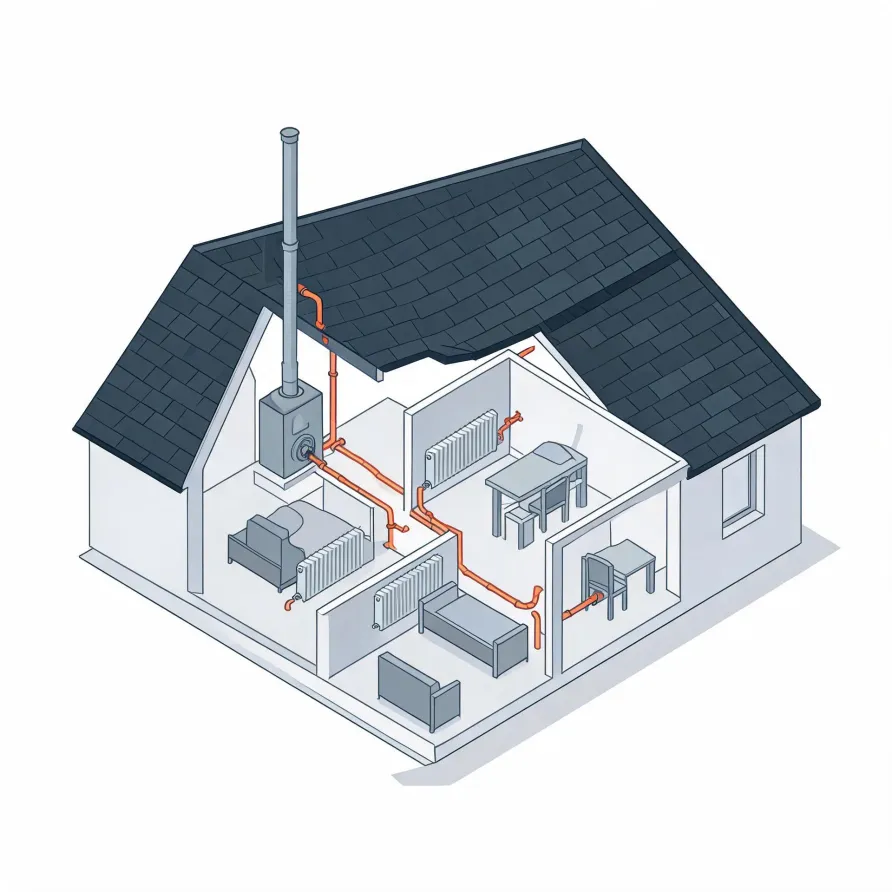
The boiler itself sits in the basement or a utility room and is the piece a contractor goes to first. It heats water and pushes it through the system. When it fails, the signs range from no heat at all to uneven warmth across rooms. The burner, heat exchanger, and pressure vessel are all part of that same unit.
Radiators or baseboard units sit in each room and release heat from the hot water moving through them. A circulator pump, usually mounted at the boiler, moves that water through the pipes. The expansion tank and pressure relief valve sit close by and are common failure points when pressure in the system goes wrong.
The drawing shows a general layout of these components, and a licensed contractor determines which ones apply to your specific system.
Get matched in Cape May CountyCape May County, by the numbers
133 severe weather events were recorded in Cape May County, New Jersey between 2015 and 2024.
NOAA National Centers for Environmental Information, Storm Events Database, bulk CSV export, events 2015-01-01 through 2024-12-31.Half the homes in Cape May County, New Jersey were built in 1981 or earlier (2020-2024 ACS 5-year).
U.S. Census Bureau, 2020-2024 American Community Survey 5-Year EstimatesCape May County, New Jersey holds 99,599 housing units (2020-2024 ACS 5-year).
U.S. Census Bureau, 2020-2024 American Community Survey 5-Year EstimatesOwners occupy 80.3% of the occupied homes in Cape May County, New Jersey (2020-2024 ACS 5-year).
U.S. Census Bureau, 2020-2024 American Community Survey 5-Year EstimatesBoiler Repair Rules on the Books for Cape May County, New Jersey2 codes, standards & licensing rules
Licensing and Legal Requirements in Cape May County, New Jersey
In New Jersey the HVACR licence is the State's alone: a municipality, local board of health or any other agency may not issue or renew a Master HVACR contractor's licence.
New Jersey requires a Master HVACR contractor licence: no person or business may engage in the business of HVACR contracting, or advertise as a Master HVACR contractor, without being authorised under the State HVACR Contracting License Law.
Severe Weather Events in Cape May County
Weather puts direct stress on boiler systems: pressure swings, hard freezes, and prolonged cold force equipment to work at its limits or bring it down entirely. How often that happens in Cape May County shapes how hard local boilers are driven and what repair work they actually need.
133 severe weather events, 2015–2024. Source: NOAA National Centers for Environmental Information, Storm Events Database.