Tell us about the job
Takes about a minute. No obligation.
Sizing a boiler for this house is not a calculation a contractor runs once and files away. The burner, the heat exchanger, and the ignition system cycle through a long working season before they get any rest. Homes in Cumberland County, NJ run heat about seven months a year, from October through April. A boiler that is undersized, or whose combustion air and venting were set up carelessly, runs harder and longer than it was designed to, and the heat exchanger is the first place that shows. A contractor quoting a new installation here has to get the load calculation right before anything else on the job matters.
Ductwork that was laid out for a different era of heating equipment is what shapes a boiler installation here more than any other single factor. Half the homes in Cumberland County, New Jersey were built in 1969 or earlier (2020-2024 ACS 5-year). That means a contractor opening walls and chases in a typical Cumberland County house is measuring whether what is already there can carry a new system, not assuming it can. Older distribution runs were sized and routed for specific loads, and a modern boiler does not inherit that fit automatically. What the existing ductwork actually allows determines the scope of the job before the new unit is ever priced.
What a New Boiler System Puts in Your Home
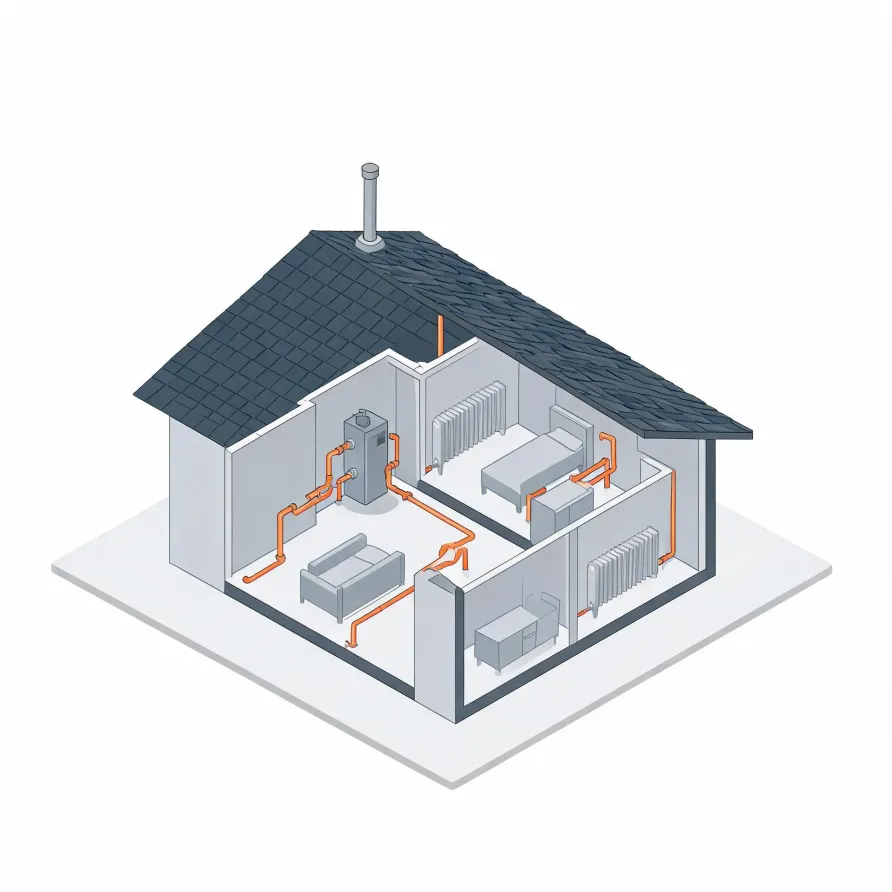
The boiler itself sits in the basement or utility room and is the unit that heats the water the system runs on. Connected to it is the expansion tank, which absorbs pressure changes as water heats and cools. Together they form the core of what a contractor installs.
From the boiler, supply pipes carry hot water to radiators or baseboard units positioned throughout the living spaces, and return pipes bring the cooled water back. A circulator pump, mounted at the boiler, keeps water moving through that loop. A thermostat on a main-floor wall ties the whole system to the temperature you set.
The drawing shows a typical layout, and a licensed contractor determines what applies to your specific home.
Get matched in Cumberland CountyCumberland County, by the numbers
105 severe weather events were recorded in Cumberland County, New Jersey between 2015 and 2024.
NOAA National Centers for Environmental Information, Storm Events Database, bulk CSV export, events 2015-01-01 through 2024-12-31.Half the homes in Cumberland County, New Jersey were built in 1969 or earlier (2020-2024 ACS 5-year).
U.S. Census Bureau, 2020-2024 American Community Survey 5-Year EstimatesCumberland County, New Jersey holds 57,282 housing units (2020-2024 ACS 5-year).
U.S. Census Bureau, 2020-2024 American Community Survey 5-Year EstimatesOwners occupy 66.5% of the occupied homes in Cumberland County, New Jersey (2020-2024 ACS 5-year).
U.S. Census Bureau, 2020-2024 American Community Survey 5-Year EstimatesBoiler Installation Rules on the Books for Cumberland County, New Jersey2 sourced standards and codes
Licensing and Legal Requirements in Cumberland County, New Jersey
In New Jersey the HVACR licence is the State's alone: a municipality, local board of health or any other agency may not issue or renew a Master HVACR contractor's licence.
New Jersey requires a Master HVACR contractor licence: no person or business may engage in the business of HVACR contracting, or advertise as a Master HVACR contractor, without being authorised under the State HVACR Contracting License Law.
Severe Weather Events in Cumberland County
Boiler systems carry the full load of keeping a home warm through whatever the local climate delivers, and that load is shaped by how hard the weather pushes back. What Cumberland County sees year over year is part of what determines how hard a boiler has to work and how quickly that wear adds up.
105 severe weather events, 2015–2024. Source: NOAA National Centers for Environmental Information, Storm Events Database.