Tell us about the job
Takes about a minute. No obligation.
Sizing a boiler for a Burlington County home requires a heat load calculation that accounts for how much the burner will actually cycle, not a rule of thumb lifted from a catalog. Homes in Burlington County, NJ run heat about seven months a year, from October through April. A burner running through that kind of sustained demand accumulates wear on the heat exchanger, the ignition system, and the circulator in a way that a marginal install cannot hide for long. A contractor quoting a replacement here will look at flue venting, combustion air supply, and radiation capacity before settling on output, because an undersized unit short-cycles and an oversized one floods the heat exchanger with condensation it was not built to handle.
Older ductwork does not simply carry whatever gets connected to it. Half the homes in Burlington County, New Jersey were built in 1977 or earlier (2020-2024 ACS 5-year). A contractor sizing and installing a boiler in stock like this has to look at what the existing distribution system was built to move, how it runs through the house, and whether it can handle what the new equipment puts out. That assessment shapes the quote, the scope, and sometimes the sequence of the work itself.
What a Boiler Installation Puts in Your Home
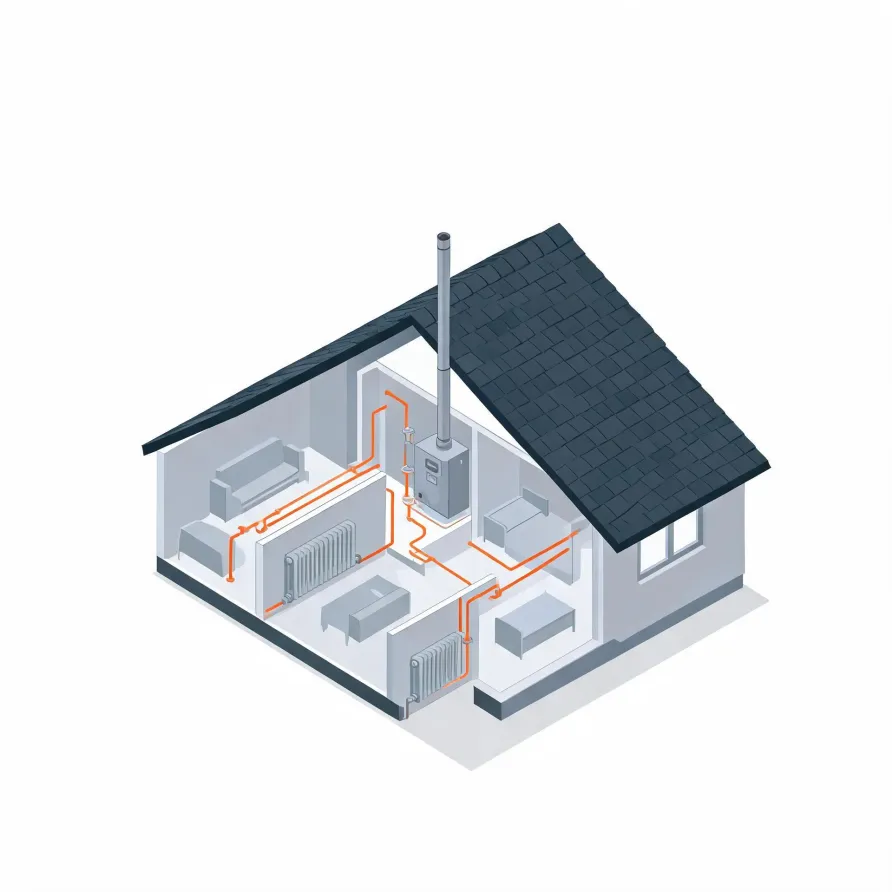
The boiler itself sits in a mechanical room, basement, or utility space and is the unit that heats the water the system runs on. Alongside it, the expansion tank absorbs pressure as the water heats and expands. Together, these are the core of what a contractor sets in place.
From the boiler, supply pipes carry hot water out to the radiators or baseboard units mounted along the walls of each room, and return pipes bring the cooled water back. A circulator pump, mounted on or near the boiler, keeps that water moving through the loop. The pressure and temperature relief valve sits on the boiler itself as a safety device.
The drawing shows a representative layout, and a licensed contractor determines exactly what applies to this house.
Get matched in Burlington CountyBurlington County, by the numbers
514 severe weather events were recorded in Burlington County, New Jersey between 2015 and 2024.
NOAA National Centers for Environmental Information, Storm Events Database, bulk CSV export, events 2015-01-01 through 2024-12-31.Half the homes in Burlington County, New Jersey were built in 1977 or earlier (2020-2024 ACS 5-year).
U.S. Census Bureau, 2020-2024 American Community Survey 5-Year EstimatesBurlington County, New Jersey holds 186,315 housing units (2020-2024 ACS 5-year).
U.S. Census Bureau, 2020-2024 American Community Survey 5-Year EstimatesOwners occupy 76.1% of the occupied homes in Burlington County, New Jersey (2020-2024 ACS 5-year).
U.S. Census Bureau, 2020-2024 American Community Survey 5-Year EstimatesBoiler Installation Rules for Burlington County, New Jersey2 codes, standards, and licensing rules
Licensing and Legal Requirements in Burlington County, New Jersey
In New Jersey the HVACR licence is the State's alone: a municipality, local board of health or any other agency may not issue or renew a Master HVACR contractor's licence.
New Jersey requires a Master HVACR contractor licence: no person or business may engage in the business of HVACR contracting, or advertise as a Master HVACR contractor, without being authorised under the State HVACR Contracting License Law.
Severe Weather Events in Burlington County
Boilers work hardest when the weather outside puts real demand on a building's heating system. How often Burlington County sees severe weather is a direct input into how much a boiler is asked to do and how well it needs to be sized and installed.
514 severe weather events, 2015–2024. Source: NOAA National Centers for Environmental Information, Storm Events Database.